
Sep
2025
15

The 6th Alignment
I was wrong and let me tell you why.
For years, the central theme of my book Aligning the Dots, my TED talk, and countless Vistage workshops has revolved around a single, essential question: How can you create the strongest possible alignment between your company and its target market to unlock maximum growth?
I also explore several critical follow-on questions: What does “alignment” truly mean? How can it be defined in a pragmatic, actionable way? Can it be scientifically measured with precision? How do you identify and rectify misalignments? And most importantly, what steps can leaders take to systematically strengthen alignment over time?
That’s the purpose of our A4 Precision Alignment™ framework, a structured methodology for CEOs and leadership teams to translate strategy into a clear, actionable Growth Playbook. It answers the Monday-morning question: What do we do at 8 a.m. to grow the business?
At its core lies what I call the Law of Alignment:
A company achieves its optimal growth rate only when it is perfectly aligned with its market along four market-facing dimensions.
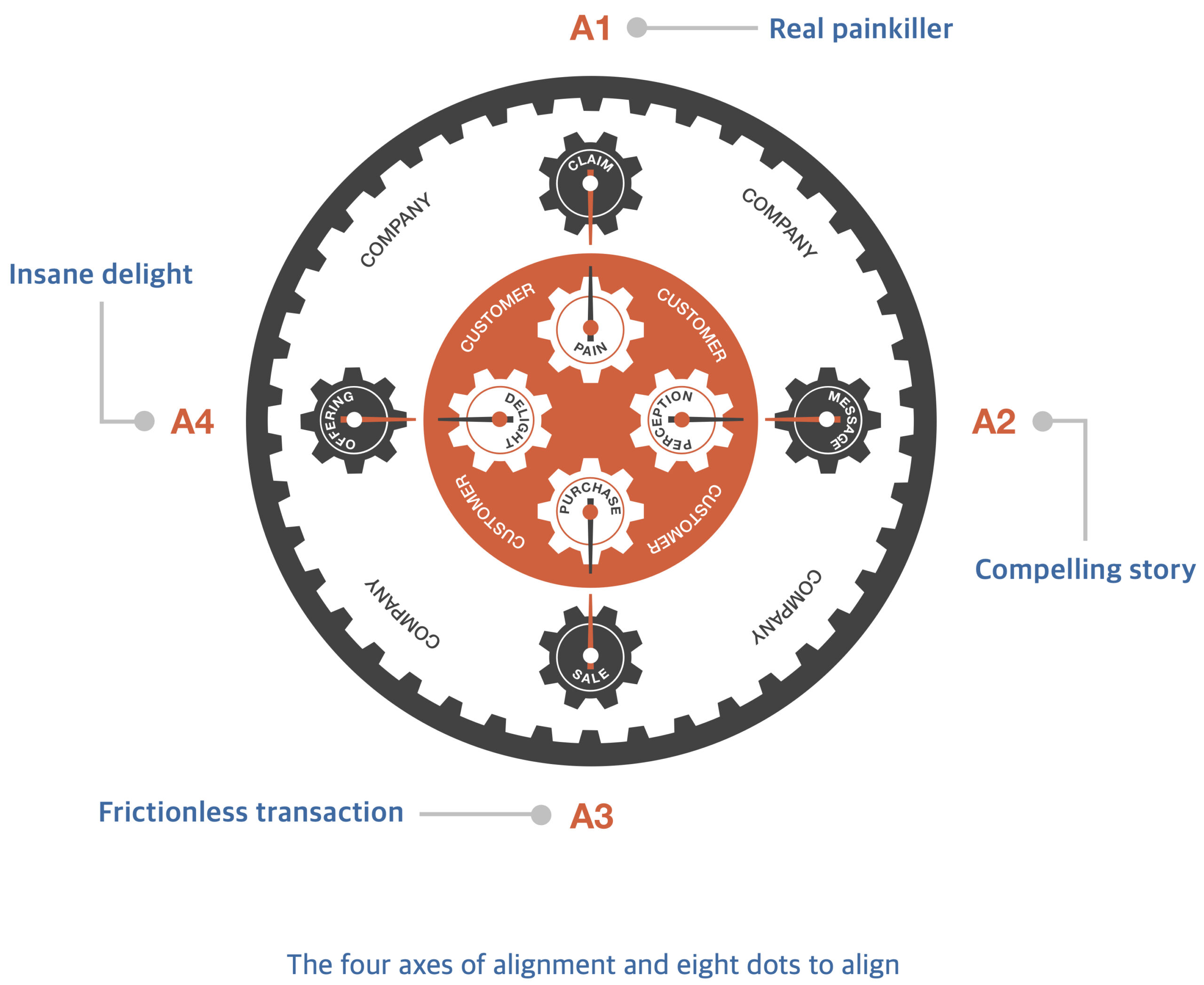
Misalignment is the silent killer of growth. It creates friction at every touchpoint—customers, prospects, partners, and quietly erodes momentum. That’s why so many companies never reach their true growth potential.
Why Four Dimensions?
This is how I originally framed alignment across these four vectors. For a long time, I tried to simplify them into three and only three alignments. One of the lessons I learned working with Steve Jobs, was that things should come in threes. “Three is perfect,” he’d say. And so, I tried, hard, to collapse my framework from four to three.
But reality wouldn’t bend. Eventually, I realized two truths:
- Life is four-dimensional. To meet someone, you need three spatial coordinates (longitude, latitude, altitude) and the fourth dimension—time.
- Physics rests on four and only four universal forces. Every interaction in the universe emerges from the strong, weak, electromagnetic, and gravitational forces. Not three. Four. That’s it!
And so, I made peace with four dimensions of market alignment.
Then came the Fifth Alignment
Then came another realization. Alignment isn’t just external—it must also be internal.
The best strategy collapses if an organization itself is fractured and misaligned. Internal Alignment, the subject of the last chapter of my book Aligning the Dots, ensures that teams, culture, and execution are in lockstep to deliver on the four market-facing alignments and generate growth.
So, the framework expanded: four external + one internal. Five in total.
The Sixth Alignment
Until recently, if you’d asked me whether there could be more than five, I would have confidently said: No. That’s it.
But I was wrong.
After serving on 25 boards, currently working closely with two, I woke up one morning with a striking realization:
There is a Sixth Alignment, and I missed it: The alignment between the CEO and the board.
The relationship between a CEO and their board, and the dynamics among board members themselves, has the power to accelerate or derail a company’s trajectory.
I have seen well-aligned boards that fuel growth with constructive challenge, sound judgment, trust and true partnership, especially in challenging times for the company. And I have seen misaligned boards that destroy shareholder value with dysfunction, selfishness and conflict.
This sixth alignment is every bit as critical as the others, and it deserves the same level of discipline and attention from CEOs who aspire to lead companies through sustained growth.
Closing Thoughts
So here I am, breaking Steve Jobs’ rule of three, not with four, not with five, but with six alignments.
And while I hope I haven’t missed a seventh, I’ve learned this much: growth depends on alignment, and alignment is always more complex and more vital than it first appears. Alignment is what makes the difference between life and death in business.